Biography of Gore Vidal | Early Life and Education and Literary Career - Personal Life - Later Years and Death of Gore Vidal

Biography of Gore Vidal:
Gore Vidal (Eugene Luther Gore Vidal) was an American writer, essayist, and public intellectual known for his prolific literary output, sharp wit, and insightful commentary on American society and politics. Born on October 3, 1925, in West Point, New York, Vidal's work spanned various genres, including novels, essays, plays, and screenplays. He was a controversial and influential figure in American literature and politics. Gore Vidal passed away on July 31, 2012.
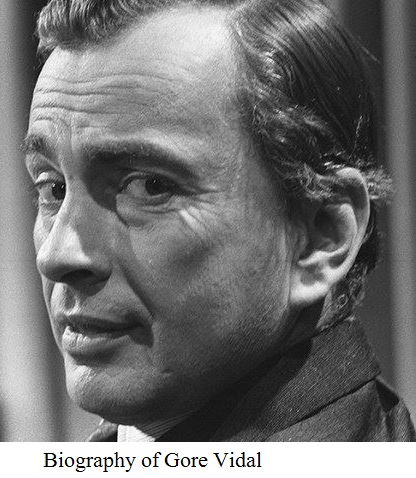 |
| Biography of Gore Vidal |
Here is a brief biography of Gore Vidal:
Gore Vidal's Early Life and Education:
Gore Vidal was born into a prominent political family. His father, Eugene Vidal, was an aviation pioneer and a founder of three airlines. His mother, Nina Gore, was the daughter of Senator Thomas Gore of Oklahoma. Vidal spent his early years in a politically engaged and intellectually stimulating environment.
After his parents' divorce, Vidal's mother remarried Hugh D. Auchincloss, stepfather to Jacqueline Kennedy, adding a connection to the Kennedy family. Vidal attended Phillips Exeter Academy in New Hampshire and later served in the U.S. Army during World War II.
Literary Career:
Gore Vidal's literary career began in the late 1940s with the publication of his first novel, "Williwaw" (1946), based on his wartime experiences. He gained widespread acclaim with his third novel, "The City and the Pillar" (1948), which was one of the first American novels to depict homosexuality openly. The novel sparked controversy but established Vidal as a bold and innovative writer.
Vidal wrote in various genres, including historical fiction, satirical novels, and essays. Notable works include the historical novels "Burr" (1973), "Lincoln" (1984), and "Empire" (1987). His satirical novels, such as "Myra Breckinridge" (1968) and "Duluth" (1983), also garnered attention for their bold and irreverent style.
Gore Vidal's Essays and Political Commentary:
In addition to his fiction, Gore Vidal was known for his essays and political commentary. He was a keen observer of American politics and society, and his essays, collected in works such as "United States: Essays 1952-1992," provided incisive critiques of political figures, institutions, and cultural trends.
Political Ambitions:
Gore Vidal had a brief foray into politics. In 1960, he ran as a Democratic candidate for Congress in New York but was unsuccessful. Despite not holding public office, he remained an influential commentator on political matters throughout his life.
Screenplays and Plays:
Vidal also wrote screenplays and plays. He co-wrote the screenplay for the film adaptation of Tennessee Williams' "Suddenly, Last Summer" (1959) and wrote the screenplay for the historical epic "Ben-Hur" (1959). His plays include "The Best Man" (1960), which was later adapted into a successful film.
Personal Life:
Gore Vidal had relationships with both men and women but did not categorize himself as gay or bisexual. He was known for his wit, charm, and acerbic sense of humor. Vidal was open about his disdain for what he saw as the decline of American culture and politics.
Later Years and Death of Gore Vidal:
In his later years, Vidal divided his time between residences in Italy and the United States. He continued to write and offer commentary on contemporary events. Gore Vidal passed away on July 31, 2012, at the age of 86, at his home in Hollywood Hills, California.
Gore Vidal's legacy is multifaceted, encompassing his contributions to American literature, his wit and intellectual prowess, and his impact on political discourse. His work remains an influential part of American literary and cultural history.
Comments
Post a Comment