
Biography of Archimedes | Early Life and Education-Contributions to Mathematics-Archimedes Principle-Legacy of Archimedes

Biography of Archimedes

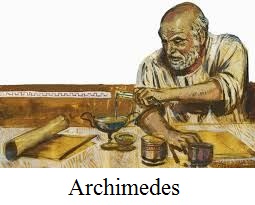
Archimedes (c. 287 – c. 212 BC) was an ancient Greek mathematician, physicist, engineer, inventor, and astronomer. He is considered one of the greatest mathematicians and scientists of antiquity. Archimedes made significant contributions to various fields, including mathematics, physics, and engineering. Unfortunately, many details of his life are not well-documented, and much of what is known about him comes from historical accounts written centuries after his death.
Biography of Archimedes

Early Life and Education:

Archimedes was born in the city of Syracuse on the eastern coast of Sicily, which was a Greek colony at the time. He was a member of an aristocratic family and received his education in Alexandria, one of the most significant centers of learning in the ancient world.


Archimedes's Contributions to Mathematics:

Archimedes made groundbreaking contributions to geometry. He calculated the value of pi (π) with remarkable accuracy, using a method of inscribing and circumscribing polygons around a circle. He also developed the concept of infinitesimals, which laid the foundation for integral calculus. Archimedes is famous for his work on areas and volumes of geometric shapes, including the computation of the surface area and volume of a sphere.

Inventions and Engineering Achievements:

Archimedes was not only a theoretical mathematician but also a practical inventor and engineer. He designed various machines and devices, including the Archimedes screw, a device for raising water. He used his understanding of levers and pulleys to invent innovative machines, such as the compound pulley system, which allowed him to move heavy objects with minimal force.

Archimedes Principle:

One of Archimedes' most famous discoveries is the principle of buoyancy, known as Archimedes' principle. According to this principle, any object submerged in a fluid (liquid or gas) experiences an upward buoyant force equal to the weight of the fluid it displaces. This principle explains why objects float or sink in fluids and is fundamental in the understanding of hydrodynamics.

Legacy of Archimedes:

Archimedes' works had a profound influence on the development of mathematics and science. His contributions were not widely recognized during his lifetime, but his writings were preserved and studied by later scholars. Archimedes' work laid the foundation for many scientific principles and concepts that are still used in modern mathematics and engineering.

Archimedes' life and achievements continue to inspire scientists, mathematicians, and engineers to this day, making him one of the most celebrated figures in the history of science.

Comments

Popular posts from this blog

Biography of Manohar Joshi

Biography of Manohar Joshi: Manohar Gajanan Joshi is an Indian politician who has played a significant role in Maharashtra state politics. Born on December 2, 1937, in a middle-class family in a village called Ganeshpeth in Ratnagiri district, Maharashtra, Joshi's journey into politics was marked by his association with the Shiv Sena, a right-wing regional political party in India. Joshi's political career began in the late 1960s when he joined the Shiv Sena, which was then led by its founder, Bal Thackeray. He quickly rose through the ranks of the party due to his organizational skills, dedication, and ideological alignment with the party's principles, which advocated for the interests of the Marathi-speaking population of Maharashtra. In 1972, Manohar Joshi won his first election to the Brihanmumbai Municipal Corporation (BMC), marking the beginning of his electoral career. He served as a corporator in the BMC and later became the Mayor of Mumbai in 1976. Joshi's tenu...

Professor Cheiro Prophecies about India | 5 predictions Professor Kiro - Kiro made these amazing predictions for India

Professor Cheiro Prophecies:  Here is Kiro made these amazing predictions for India: Professor Kiro was born in November 1866 in England. At the age of 17, Kiro came to Mumbai and met astrologer Vednarayan Joshi. With his advice, he will reach the Himalayas, Kashmir, Ladakh and Varanasi. From here, he studied astrology extensively. Kiro made many predictions in his life, which we are giving you here. Cheiro, whose real name was William John Warner, was a prominent Irish astrologer and palmist who gained fame in the late 19th and early 20th centuries. He was known for his accurate predictions and was consulted by various prominent figures of his time, including Mark Twain, Oscar Wilde, and Thomas Edison. Cheiro also made some predictions related to India. Parada Kahanee One of his notable predictions about India was made in his book "Cheiro's World Predictions," published in 1926. In this book, he wrote about the possibility of India gaining independence from British...

Biography of Abbie Hoffman | Early Life and Political Activism - Later Years and Personal Life - Legacy of Abbie Hoffman

Biography of Abbie Hoffman: Abbie Hoffman (November 30, 1936 – April 12, 1989) was an American political and social activist known for his involvement in the counterculture and anti-war movements of the 1960s and 1970s. He was a key figure in the Youth International Party (Yippies) and was known for his theatrical and often humorous protests.  Here is a brief biography of Abbie Hoffman: Early Life of Abbie Hoffman: 1. Birth: Abbie Hoffman was born on November 30, 1936, in Worcester, Massachusetts, USA. 2. Education: He attended Brandeis University, where he earned a degree in psychology in 1959. Parada Kahanee Political Activism: 1. Civil Rights Movement: Hoffman began his activism by participating in the civil rights movement during the early 1960s. 2. Youth International Party (Yippies): In 1967, Hoffman, along with Jerry Rubin and others, co-founded the Yippies, a countercultural and anti-authoritarian political party known for its unconventional and theatrical protes...